Kipu Quantum Builds the Quantum One-Stop-Shop for Industrial Quantum Usefulness
Through expanded collaboration with IBM, Kipu Quantum starts to provide developers with quantum algorithms capable of outperforming classical baselines of 48 x 2.3 GHz and 123 GB RAM on IBM Quantum hardware.
Industrial Quantum Usefulness
Quantum usefulness in industry applications depends on delivery. Two challenges stand between research results and business value: turning algorithms into production-ready tools and finding problems worth solving. The first is infrastructure: APIs that let developers build without having quantum PhDs. The second is discovery: matching quantum's strengths to real business pain points. Not every hard problem needs quantum. Not every quantum solution solves a problem anyone has. Kipu’s expanded role with IBM aligns with handling the full lifecycle: build the science, sell it in APIs, service end-user applications.
Beating Classical with Quantum Algorithms
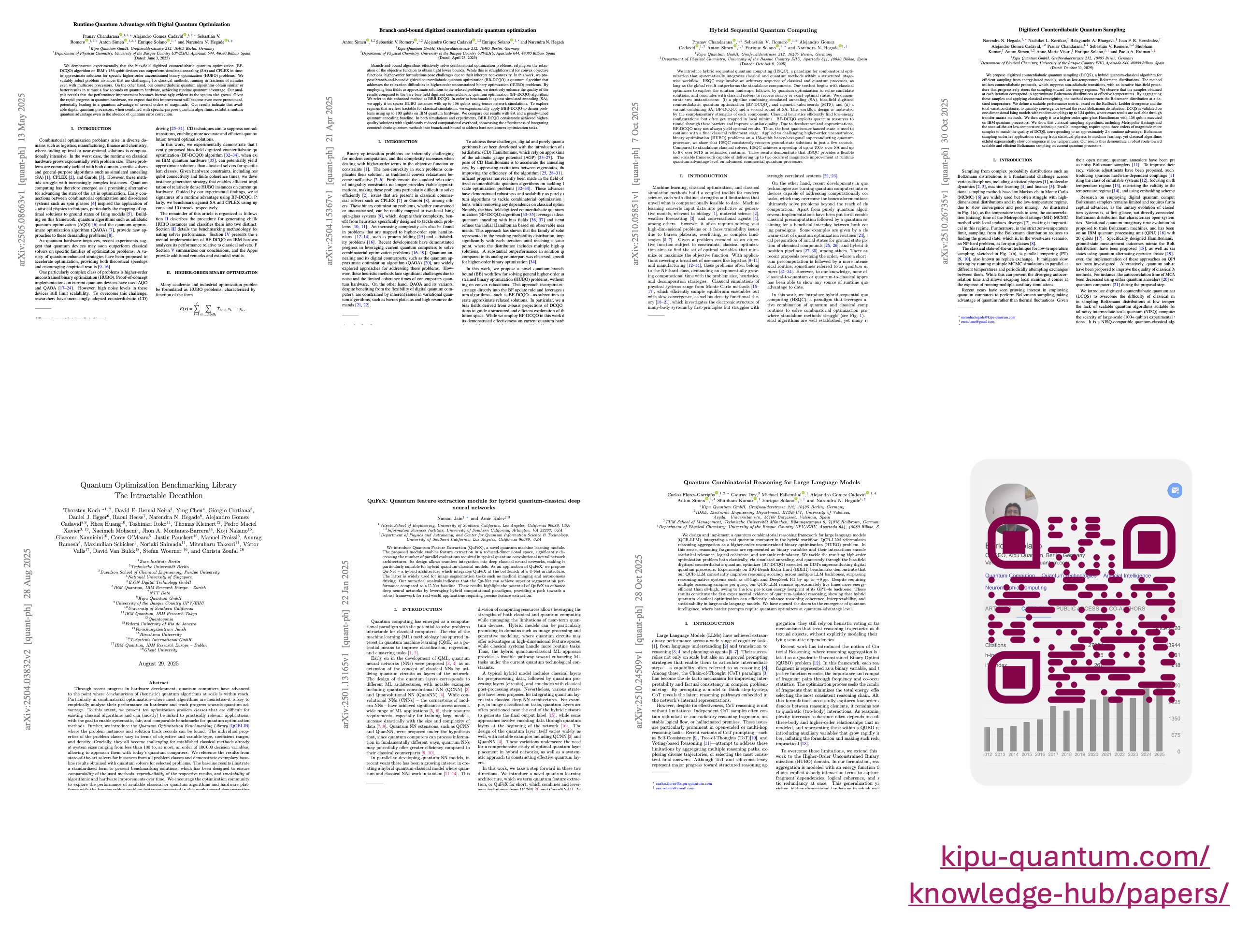
Using a 156-qubit IBM Quantum Heron processor, you can find approximate solutions for a class of HUBO (Higher-Order Unconstrained Binary Optimization) problems faster than classical baselines. The Quantum Optimization Benchmarking Library, maintained by the Quantum Optimization Working Group, provides standardized HUBO test instances for comparing quantum and classical approaches. On selected benchmarks, Kipu's optimization technology surpassed CPLEX and Gurobi (with access to at least 48 cores x 2.3 GHz and 123 GB RAM) as well as best-in-class classical Tabu Search.
Speed Advantage:
- Bias Field-DCQO: 80x faster binary optimization than CPLEX, and 12x faster than Simulated Annealing (using 156 qubits of IBM Heron processor-powered quantum computers: ibm_marrakesh, and ibm_kingston) [1]
- Hybrid Sequential Quantum Computing: 700x vs. Simulated Annealing, 9x vs. Tabu Search using Classical (SA) → Quantum (BF-DCQO) → Classical (MTS/SA) sequence (using 156 qubits of IBM Heron processor-powered quantum computers: ibm_kingston, ibm_marrakesh, and ibm_aachen) [2]
Efficiency Advantage:
- Hybrid Classical-Quantum Sampling: 10³ fewer samples needed for low-temperature Boltzmann distributions (using 156 qubits of IBM Heron processor-powered quantum computer: ibm_marrakesh) [3]
- Quantum Reasoning-LLM (using Iskay): 5x fewer tokens while reaching o3-level reasoning performance on BIG-Bench Hard benchmark with non-reasoning native GPT-4o (using 120 qubits of IBM Heron process-powered quantum computer: ibm_aachen) [4]
Scaling Advantage:
- LABS Optimization: Quantum Enhanced-Memetic Tabu Search scales as O(1.24N) vs. best classical O(1.34N) and quantum QAOA O(1.46N), achieving 6x less circuit depth (experimental validation up to 20 qubits on IBM Heron processor-powered quantum computer: ibm_marrakesh) [5]
Accuracy Advantage:
- Quantum Feature Extraction (Machine Learning): +5% Area under the Curve (AUC) boost in Support Vector Classification, outperforming Google Vision (0.919) with 11×10⁶ parameters (using 156 qubits on IBM Heron processor-powered quantum computer: ibm_kingston) [7]
These results mark the shift, where quantum hardware combined with world-class software offers superior capabilities for a class of mathematical problems in scaling, accuracy, speed, and energy. Validated benchmarks, as compared between certain, finite classical resources and utility-scale quantum hardware shift the objective: expand the expected advantage catalog and discover where quantum outperforms classical business computations.
From Notebooks to Services
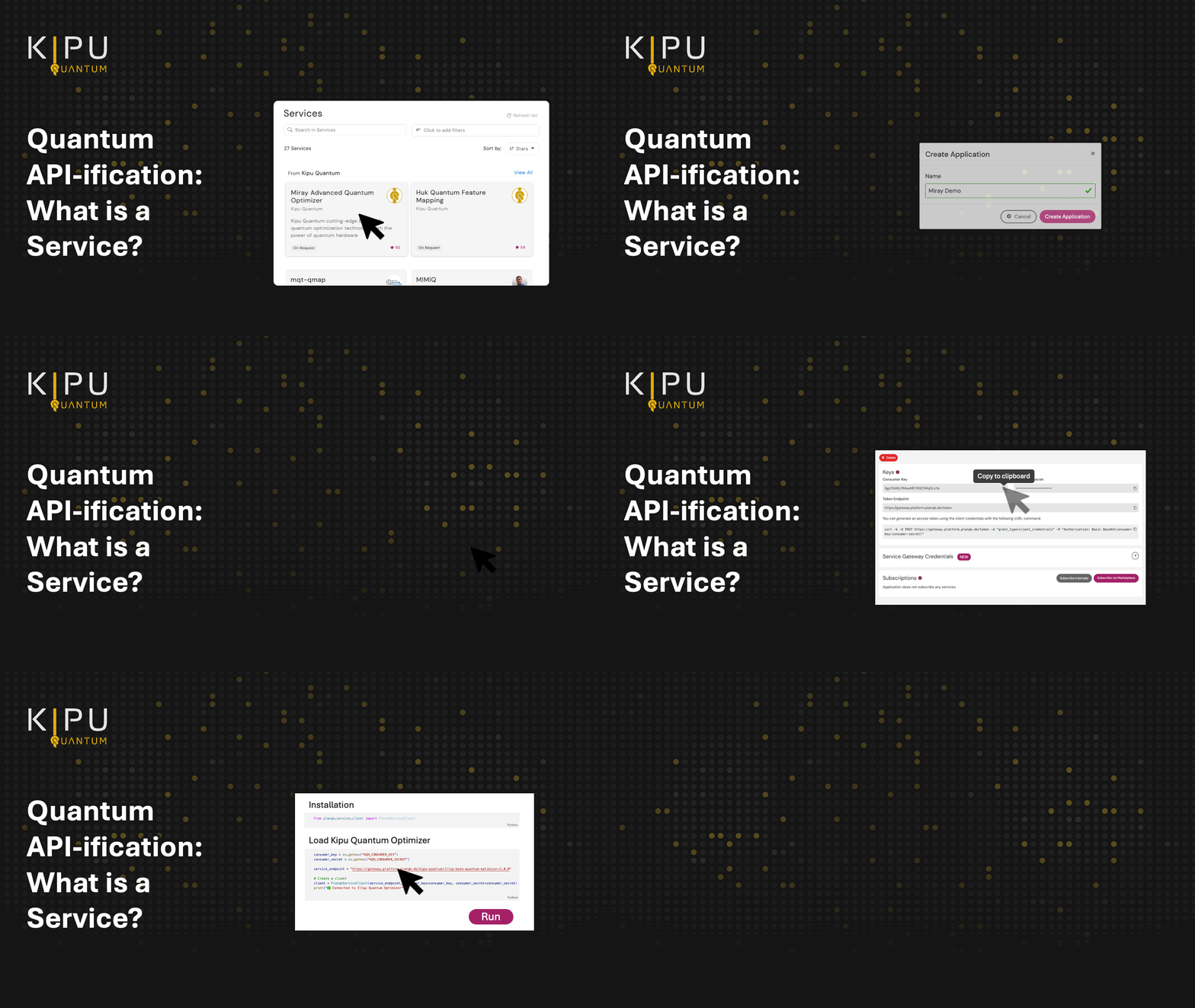
On November 12, 2025, a developer at the IBM Quantum Developer Conference loaded ms_5_100, a specific problem definition of the Market Split problem from the Quantum Benchmarking Library that's classically hard to solve and demanding on quantum hardware. The developer ran Kipu's Iskay Quantum Optimizer via the Qiskit Functions Catalogue, deployed to an IBM quantum computer over the cloud using Qiskit. The problem required a high circuit depth with 40 qubits. It solved. Minutes to result. No quantum expertise required.
What made this possible? Iskay integrates tunable pre- and post-processing with a counterdiabatic quantum approach, compressing circuit depth to fit within hardware constraints. The result: a problem that would exhaust both quantum and classical computers becomes solvable. Algorithms like Iskay now deploy through standardized APIs, letting domain experts build quantum workflows without writing quantum code.
About Kipu Quantum
Kipu Quantum operates in the Industrial Quantum Usefulness era. With computational quantum advantage achieved across optimization, machine learning, and AI applications, the German company focuses on market-ready platform productization through the Kipu Quantum Hub. Kipu's roadmap prioritizes curated quantum-advantage technologies, customer-validated prototypes, and strategic hardware partnerships. The company pioneers Agentic Quantum Computing: integrating AI agents directly into quantum workflows to accelerate industrial usefulness. Over 300 organizations currently use the Kipu Quantum Hub.
References
[1] Pranav Chandarana, Alejandro G. Cadavid, et al. (2025). “Runtime Quantum Advantage with Digital Quantum Optimization [using BF-DCQO]” arXiv:2505.08663
[2] Pranav Chandarana, Sebastián V. Romero, et al. (2025). “Hybrid Sequential Quantum Computing” arXiv:2510.05851
[3] Narendra N. Hegade, Nachiket L. Kortikar, et al. (2025) “Digitized Counterdiabatic Quantum Sampling” arXiv:2510.26735
[4] Carlos Flores-Garrigos, Gaurav Dev, et al. (2025). “Quantum Combinatorial Reasoning for Large Language Models” arXiv:2510.24509
[5] Alejandro G. Cadavid, Pranav Chandarana, et al. (2025). “Scaling advantage with quantum-enhanced memetic tabu search for LABS” arXiv:2511.04553
[6] Anton Simen, Sebastián V. Romero, et al. (2025). "Branch-and-Bound Digitized Counterdiabatic Quantum Optimization.” arXiv:2504.15367
[7] Anton Simen, Carlos Flores-Garrigós, et al. (2025). “Digitized Counterdiabatic Quantum Feature Extraction” arXiv:2510.13807