 Nature Computational Science
 Communications Physics
 Kipu Quantum Hub
 Qiskit Functions
Solve binary optimization problems with QPUs
from qiskit_ibm_catalog import QiskitFunctionsCatalog  # pip install qiskit-ibm-catalog

catalog = QiskitFunctionsCatalog(
    token=IBM_TOKEN, channel="ibm_quantum_platform", instance=INSTANCE_CRN,
)
iskay = catalog.load("kipu-quantum/iskay-quantum-optimizer")

# Objective as a QUBO/HUBO. Higher-order terms are native.
hubo = {
    "()": 0.0,          # constant
    "(0,)": -1.0,       # linear
    "(1,)": -1.0,
    "(0, 1)": 2.0,      # quadratic (QUBO)
    "(0, 1, 2)": -1.5,  # cubic (HUBO), no extra qubits
}

job = iskay.run(
    problem=hubo,
    problem_type="binary",
    instance=INSTANCE_CRN,
    backend_name="ibm_fez",
    options={"shots": 100, "num_iterations": 3},
)

result = job.result()
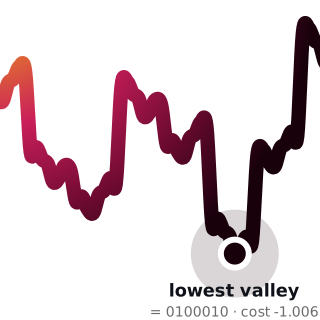
print(result["solution_info"]["cost"], result["solution"])Used and published on real quantum hardware
“Kipu's Qiskit Function radically shortened the path from QUBO/HUBO formulation to execution on real 156-qubit hardware, freeing me to focus on tuning the quantum algorithm itself.”
Khanyisa Noganta
Principal Data Scientist · Market Split winner

“Khanyisa won by tuning the parameters. It's proof that Kipu's Iskay Qiskit function works in practice. The new features allowed participants and other users to cater the function to their needs.”
Junye Huang
IBM Quantum · ran the QDC25 challenge
“We're probing quantum utility by extracting combinatorially hard scheduling subproblems and encoding them to fit NISQ-sized QPUs while keeping circuits as shallow as possible. With Kipu's proven Iskay Optimizer, we can study solution-quality distributions in a hardware-realistic setting.”
The Depth Compressors
P. Kulkarni & A. Atre · BVG Optimization Challenge
“The results are excellent: a perfect 222-edge cut at 100 nodes, and 318 of 336 at 150.”
Quantum team
Financial services · Max-Cut benchmark

“The function has been working well. We're scaling from 20 to 150 qubits on S&P 500 data.”
Data-science team
Global IT consultancy · portfolio optimization
“I tested a larger problem and it works. Now I'm pushing to even larger instances.”
Optimization researcher
University research group · vehicle routing
“With the recommended settings, our circuit dropped from 1901 to 1041 layers and 11,919 to 5,112 gates. Very useful.”
Quantum researcher
University research group · biomedical HUBO


Kipu Quantum commercializes large optimization problems application on IBM's Qiskit Functions Catalog
The Quantum Insider, 18 March 2025
Read the story
“Kipu's Qiskit Function radically shortened the path from QUBO/HUBO formulation to execution on real 156-qubit hardware, freeing me to focus on tuning the quantum algorithm itself.”
Khanyisa Noganta
Principal Data Scientist · Market Split winner
“We're probing quantum utility by extracting combinatorially hard scheduling subproblems and encoding them to fit NISQ-sized QPUs while keeping circuits as shallow as possible. With Kipu's proven Iskay Optimizer, we can study solution-quality distributions in a hardware-realistic setting.”
The Depth Compressors
P. Kulkarni & A. Atre · BVG Optimization Challenge
“The function has been working well. We're scaling from 20 to 150 qubits on S&P 500 data.”
Data-science team
Global IT consultancy · portfolio optimization
“With the recommended settings, our circuit dropped from 1901 to 1041 layers and 11,919 to 5,112 gates. Very useful.”
Quantum researcher
University research group · biomedical HUBO
“Khanyisa won by tuning the parameters. It's proof that Kipu's Iskay Qiskit function works in practice. The new features allowed participants and other users to cater the function to their needs.”
Junye Huang
IBM Quantum · ran the QDC25 challenge
“The results are excellent: a perfect 222-edge cut at 100 nodes, and 318 of 336 at 150.”
Quantum team
Financial services · Max-Cut benchmark
“I tested a larger problem and it works. Now I'm pushing to even larger instances.”
Optimization researcher
University research group · vehicle routing
Kipu Quantum commercializes large optimization problems application on IBM's Qiskit Functions Catalog
The Quantum Insider, 18 March 2025
Read the story
“Khanyisa won by tuning the parameters. It's proof that Kipu's Iskay Qiskit function works in practice. The new features allowed participants and other users to cater the function to their needs.”
Junye Huang
IBM Quantum · ran the QDC25 challenge
“The function has been working well. We're scaling from 20 to 150 qubits on S&P 500 data.”
Data-science team
Global IT consultancy · portfolio optimization
“Kipu's Qiskit Function radically shortened the path from QUBO/HUBO formulation to execution on real 156-qubit hardware, freeing me to focus on tuning the quantum algorithm itself.”
Khanyisa Noganta
Principal Data Scientist · Market Split winner
“The results are excellent: a perfect 222-edge cut at 100 nodes, and 318 of 336 at 150.”
Quantum team
Financial services · Max-Cut benchmark
“With the recommended settings, our circuit dropped from 1901 to 1041 layers and 11,919 to 5,112 gates. Very useful.”
Quantum researcher
University research group · biomedical HUBO
Kipu Quantum commercializes large optimization problems application on IBM's Qiskit Functions Catalog
The Quantum Insider, 18 March 2025
Read the story
“We're probing quantum utility by extracting combinatorially hard scheduling subproblems and encoding them to fit NISQ-sized QPUs while keeping circuits as shallow as possible. With Kipu's proven Iskay Optimizer, we can study solution-quality distributions in a hardware-realistic setting.”
The Depth Compressors
P. Kulkarni & A. Atre · BVG Optimization Challenge
“I tested a larger problem and it works. Now I'm pushing to even larger instances.”
Optimization researcher
University research group · vehicle routing
Questions, answered
What algorithm powers Iskay?
Bias-field digitized counterdiabatic quantum optimization (BF-DCQO). It is non-variational, so it runs as a purely iterative loop with no classical parameter training to get stuck in. Counterdiabatic protocols compress circuit depth to fit today's gate-based devices, and each round updates bias fields from the lowest-energy samples to steer the next evolution toward better solutions.
What problems can Iskay solve?
Any unconstrained binary optimization problem, both QUBO (quadratic) and HUBO (higher-order), with higher-order terms run natively. The BF-DCQO engine behind Iskay has been demonstrated on quantum hardware for portfolio selection on a 250-asset S&P 500 universe, lattice protein folding, MAX 4-SAT and dense spin-glass models. Scheduling, routing and other logistics problems fit the same engine once they are written as a QUBO or HUBO.
Why solve HUBO natively instead of converting to QUBO?
Forcing a higher-order problem into a quadratic QUBO form requires auxiliary qubits, and their number grows quickly with problem size and interaction order. Iskay encodes higher-order terms directly, so the reduction costs no extra qubits and a larger problem fits within the same hardware budget.
What hardware does Iskay run on?
Iskay runs on IBM Quantum hardware through the Qiskit Functions Catalog, catalogued as kipu-quantum/iskay-quantum-optimizer. The same BF-DCQO engine is available as Miray on the Kipu Quantum Hub, where it also runs on IBM Quantum hardware and comes with a free simulator version for development and testing.
How do I get started?
Load Iskay from the IBM Qiskit Functions Catalog and pass your objective as a QUBO or HUBO, or start with the free Miray simulator on the Kipu Quantum Hub and contact Kipu for access to the hardware version. Pre- and post-processing are managed, so you only provide the problem.